
Phew Blog
Mar 3, 2026
A strong content engine is not about posting every day. It is about building a system you can repeat without burning out, abandoning it, or turning your week into admin.
That is the mistake a lot of teams make. They copy a creator workflow that only works if content is your full-time job, then wonder why the system collapses after two weeks.
A better engine is smaller, more grounded, and built around real work.
Most people overestimate the value of one impressive post and underestimate the value of steady visibility over time.
Consistency compounds because it keeps your voice familiar. It lowers the pressure on any one post. And it gives your audience more chances to understand what you care about and what you are good at.
That does not mean high volume always wins. It means repeatability matters more than ambition.
You read something useful, notice a pattern in a customer call, react to a market shift, and then lose all of it because nothing lives in one system.
Every publishing session starts from zero. No angles bank. No draft queue. No way to tell what should turn into a post and what should stay a note.
Teams build a workflow that would impress a consultant but does not survive a normal Tuesday.
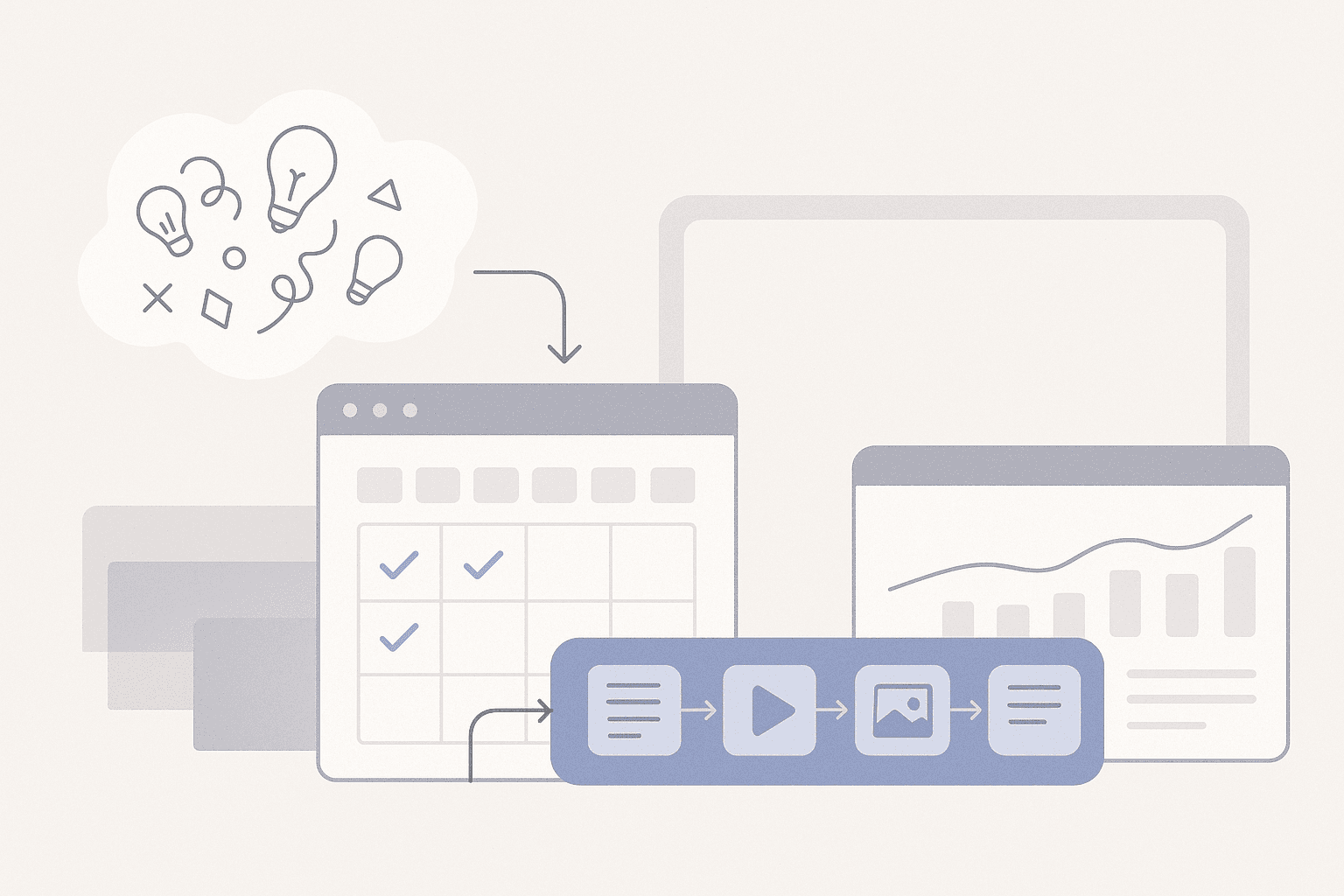
A practical engine has four parts.
Keep one place for articles, notes, conversations, screenshots, customer questions, and observations worth revisiting.
Turn raw material into usable viewpoints, lessons, reactions, frameworks, and opinions.
Convert the strongest angles into publishable drafts while the idea still feels alive.
Pick a realistic cadence so you are not renegotiating your process every week.
You do not need a giant editorial ceremony.
One weekly block is often enough. Use the first part to collect signal, the second to choose angles, and the third to turn the best ones into drafts.
That is a much better system than waiting for inspiration and hoping a good post appears before the week ends.
Batch collection. It saves attention.
Batch drafting. It keeps momentum high.
Do not over-batch tone. That is how posts start sounding interchangeable.
The point of a content engine is not to flatten your voice. It is to reduce friction without reducing recognizability.
A good system should make publishing feel lighter after a few weeks, not heavier.
You should have fewer blank-page moments, fewer content gaps, and a clearer sense of what kinds of ideas actually suit your voice.
If the system creates more coordination than output, it is broken. If it creates a small but reliable flow of publishable work, it is doing its job.
They spend too much time arguing about channels, formats, and calendars before they have solved the more basic question of signal.
If you do not have a clean way to notice what is worth saying, the rest of the engine becomes ornamental.
The strongest systems are not always the most sophisticated. They are the ones that repeatedly turn real work into public thinking.
Phew helps when the bottleneck is not just writing. It helps when the real problem is deciding what matters, shaping it in your voice, and getting from signal to post without so much friction that the moment dies.
That matters for busy professionals because relevance is usually the harder problem than output volume.
Do not design for your best week. Design for a normal week.
Do not confuse more channels with more leverage. Start with one channel you actually care about.
Do not let the system become heavier than the publishing. A content engine that creates more admin than output is not an engine. It is drag.
A good content engine should make publishing feel more repeatable, more grounded, and less emotionally expensive.
If your process depends on motivation, it will break. If it depends on a system that respects how you actually work, it can compound.
If you do want to try Phew free for 7 days and see your social score, here is where to start.